If you're planning a pole barn in Waverly, Humphreys County, or anywhere in Middle Tennessee, you probably have questions about permits, site work, and how long the whole thing takes. The good news is that pole barns are one of the most straightforward construction projects out there—but the rules vary a lot depending on where your property sits and what you're using the building for. Here's what local buyers need to know before they start.
Do I need a permit to build a pole barn in Humphreys County?
It depends on where your property is and what you're building. In unincorporated Humphreys County—meaning outside city limits—no building permit is required for a pole barn. If your land sits inside city limits (Waverly, New Johnsonville, or McEwen), you'll need to pull a building permit from the city. And if your county property is close to city limits, you may need a separately purchased zoning permit even if no building permit is required.
That's the rule for Humphreys County specifically. For every other county PAC serves—Houston County, Benton County, Perry County, Dickson County, Henry County, and beyond—the rules vary. Some rural counties have no building code enforcement at all in unincorporated areas. Others require permits depending on the structure's size, use, or location. Cities almost always require a permit.
The best step is to call your county codes office (or city hall if you're in town) and confirm what's required for your specific site. PAC can help you figure out who to call, but the permit itself is the property owner's responsibility.
Do I need engineered plans for a pole barn?
Not always. PAC provides building drawings engineered to meet Middle Tennessee's design loads—10 psf ground snow load and 90 mph wind speed. Those drawings are included with every pole barn project. Whether you need plans stamped by a professional engineer (a PE stamp) depends entirely on your local codes department and whether your site is inside city limits.
Many rural Middle Tennessee counties, including Humphreys County, do not require PE-stamped plans. Some cities and a few counties do. If your jurisdiction requires stamped plans, PAC can provide them on request—there's an added cost and a bit of lead time, but it's straightforward.
Don't assume you need stamped plans just because you're building something permanent. Check with your local office first, and PAC will provide whatever documentation your county or city requires.
What does site prep involve for a pole barn?
Pole barns need a level, well-drained site. The posts are set in concrete footings or directly embedded in the ground, depending on soil conditions and the engineer's specifications. If your land is sloped, wet, or uneven, you'll likely need some grading, gravel fill, or drainage work before construction starts.
Common site prep steps include:
- Clearing and leveling: removing brush, stumps, or debris and grading the footprint to a level pad.
- Gravel base: laying crushed stone for drainage and a clean, dry floor (especially important if you're not pouring a concrete slab).
- Drainage: grading around the building to direct water away, or adding French drains if the site holds water.
- Access: making sure trucks and equipment can reach the site to deliver materials and work safely.
The amount of prep depends on your land. A flat, dry pasture in Humphreys County or Houston County might need nothing more than a gravel pad. A sloped lot in the hills around Linden or Centerville could require more grading and fill. PAC will walk the site with you and let you know what's needed before the project starts.
Get a free, no-pressure quote at pacbuildingpro.com or call (931) 296-2777.
How long does it take to build a pole barn in Middle Tennessee?
A typical pole barn project on prepared land with permits in hand can be completed in two to six weeks, depending on the size of the building, the weather, and crew availability. A simple 30×40 shell might go up in two or three weeks. A larger 40×60 or 50×80 with doors, windows, and interior work will take longer.
Keep in mind that timeline starts once the site is ready and any required permits are issued. Permit processing time varies widely by jurisdiction—some counties turn around permits in a few days, others take a few weeks. Site prep, material delivery, and seasonal weather (especially heavy rain or frozen ground in winter) all add time to the front end.
PAC serves a wide area from Waverly out to Dickson, Camden, Paris, Erin, and beyond, and we schedule projects as efficiently as possible. But every job is different, so we'll give you a realistic timeline when we quote your project.
What sizes and uses work well for a pole barn?
Pole barns are incredibly flexible. You can build a simple three-sided shelter for livestock or hay, a fully enclosed shell for equipment storage, or a finished building with insulation, electric, and HVAC. Here are a few common sizes and what they're used for:
| Size | Square Footage | Common Uses |
|---|---|---|
| 30×40 | 1,200 sq ft | Equipment storage, small workshop, livestock shelter |
| 40×60 | 2,400 sq ft | Multiple vehicle bays, larger shop, mixed use |
| 50×80 or larger | 4,000+ sq ft | Commercial ag operations, barndominiums, large equipment |
A 30×40 is a popular starter size in Humphreys County and the surrounding counties—big enough to store a tractor, a couple of trucks, and shop tools, but not so large that it breaks the budget. A 40×60 gives you room to grow, with space for a workshop on one end and vehicle storage on the other. And if you're looking at a barndominium or a commercial farm building, 50×80 and up is typical.
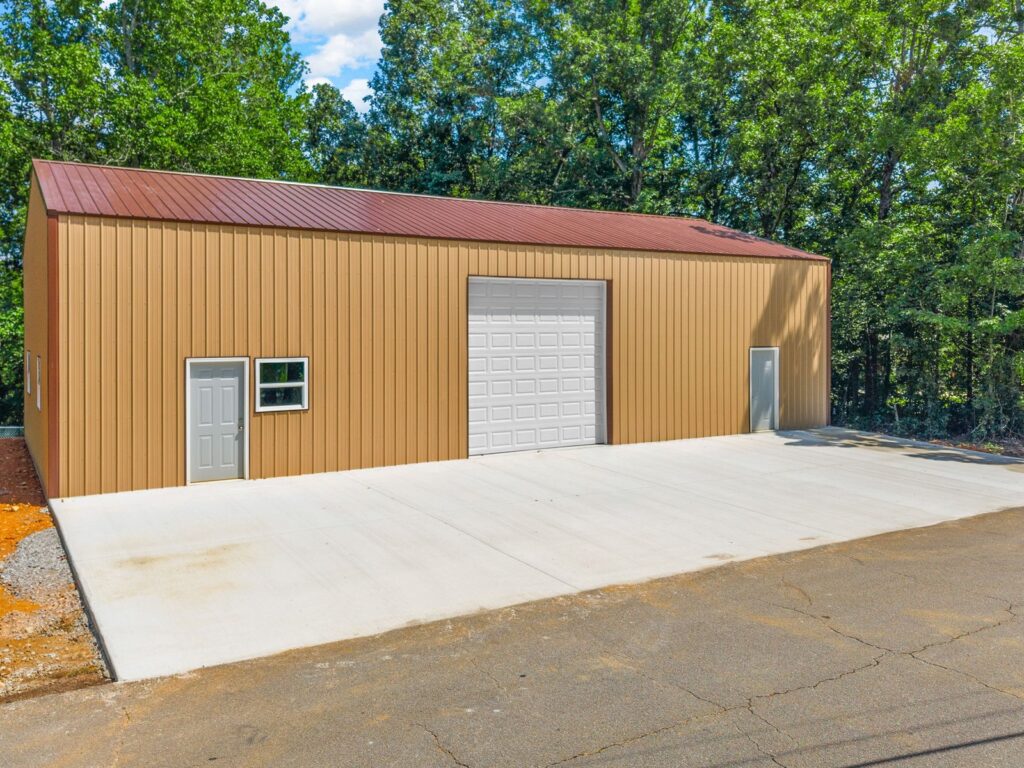
Pole barns can be built as bare shells (just posts, roof, and siding) or finished buildings with insulated walls, overhead doors, walk doors, windows, electrical wiring, and even plumbing rough-in. The cost depends on the size and what you want inside, so the best thing to do is call PAC and talk through what you're planning.
Pole barn or stud-frame: which is right for your project?
PAC builds both post-frame (pole barn) and stud-frame (stick-built) garages, shops, and buildings. A lot of buyers don't realize there's a choice, so here's the difference:
- Post-frame (pole barn): vertical posts set in the ground or in concrete footings carry the load. Faster to build, uses less lumber, and often more affordable for larger buildings. Great for ag use, workshops, and wide-open interiors.
- Stud-frame (stick-built): built on a concrete slab or footer foundation with wall studs every 16 or 24 inches, just like a house. Easier to insulate and finish on the inside, and some lenders or HOAs prefer this method. Common for residential garages and finished workshops.
Both methods are strong, durable, and designed to the same snow and wind loads for Middle Tennessee. The right choice depends on your budget, your intended use, and whether you need a foundation for financing or local code reasons. PAC can build either one, so we'll help you pick what fits your project best.
What affects the cost of a pole barn?
Every pole barn is custom, so cost depends on a long list of variables. The biggest factors are size, features, and finish level. A bare shell costs far less than a fully finished, insulated building with electric and HVAC. Here's what drives the price:
- Size: square footage and roof height.
- Doors and openings: overhead doors, walk doors, windows, and the number of each.
- Insulation: whether you insulate the walls and ceiling, and what R-value you choose.
- Wiring and plumbing: electrical service, lighting, outlets, and any plumbing rough-in.
- Siding and roofing: metal panel type, color, and upgrades like standing-seam or stone wainscoting.
- Site conditions: how much grading, gravel, or drainage work is needed before construction starts.
- Location: labor and travel vary depending on where your site is within PAC's service area.
PAC offers financing for pole barns (financed builds are not the same as rent-to-own; financing involves a credit application and approval). The best way to get an accurate number is to request a free quote. PAC will ask about your size, features, and site, then provide a detailed estimate with no pressure to buy.
Does PAC serve my area for pole barn construction?
PAC is based in Waverly and serves a roughly 70-mile radius across Middle Tennessee. We build pole barns on-site in Humphreys County (Waverly, New Johnsonville, McEwen, Hurricane Mills), Houston County (Erin, Tennessee Ridge), Benton County (Camden, Big Sandy), Perry County (Linden, Lobelville), Hickman County (Centerville), Dickson County (Dickson, White Bluff, Burns, Charlotte), and Henry County (Paris, Puryear, Springville).
We also build and deliver to Robertson County (Springfield, Greenbrier, White House), Cheatham County (Ashland City, Kingston Springs, Pegram, Pleasant View), Davidson County (Nashville), Williamson County (Franklin, Fairview), Maury County (Columbia, Spring Hill), and many other Middle Tennessee counties. If you're located farther out—like Jackson, Lawrenceburg, Savannah, or Martin—PAC still builds and delivers there; just call to confirm lead time and scheduling.
PAC does not do on-site construction across the state line in Kentucky. We deliver prefab packages (portable buildings, carports, prefab metal garages) to Murray, Cadiz, and Hopkinsville, but pole barns and custom builds stay on the Tennessee side.
Frequently Asked Questions
Do I need a permit for a pole barn on my farm in Humphreys County?
In unincorporated Humphreys County, no building permit is required. Inside city limits (Waverly, New Johnsonville, McEwen), you'll need a permit from the city. Agricultural buildings used for farming may be exempt from state codes under Tennessee law, but local enforcement varies, so confirm with your county or city office.
How long does a pole barn last in Middle Tennessee?
A well-built pole barn with proper maintenance can last 40 to 60 years or more. Middle Tennessee's climate—10 psf snow load and 90 mph wind—is manageable for pole barn construction, and metal roofing and siding hold up well in our wet winters and hot summers.
Can PAC provide stamped engineered plans if my county requires them?
Yes. PAC provides building drawings engineered to local snow and wind loads with every pole barn. If your county or city requires plans stamped by a professional engineer (PE stamp), PAC can provide them on request for an added cost and lead time.
Can I finance a pole barn, or is it rent-to-own?
PAC offers financing for pole barns, which involves a credit application and approval. Pole barns are not available on a rent-to-own or no-credit-check basis—those options apply only to delivered prefab buildings like portable sheds and metal carports.
Ready to start your project? PAC Building Pro serves Waverly, Humphreys County, and Middle Tennessee with custom pole barns built on your property. Get a free quote at pacbuildingpro.com or call (931) 296-2777 to talk through your plan, your site, and what permits you'll need. No pressure, just straight answers from a local builder who knows the area.