If you're looking at pole barn projects in Humphreys County or the surrounding Middle Tennessee counties, it helps to see what actually gets built on rural property around here. We're PAC Building Pro in Waverly, and we've put up post-frame buildings across this part of Tennessee—from simple equipment storage to full workshop builds. Here are five types of pole barn projects we regularly build for customers in Humphreys, Houston, Benton, Perry, Dickson, Hickman, and the surrounding areas, with a few notes on what makes each one work.
What Pole Barn Projects Do People Build in Humphreys County and Middle Tennessee?
Pole barns around here serve working farms, rural homesteads, and property owners who need shelter for equipment or vehicles. The five most common projects we build are equipment storage, workshop and farm shop buildings, livestock shelters, vehicle and RV garages, and combination-use barns that serve more than one purpose.
Each one is a custom post-frame structure built on your property, with pressure-treated posts set in the ground or on concrete pads and 29-gauge steel roof and wall panels. PAC provides building drawings engineered for the local snow and wind loads in your county—typically 10 pounds per square foot ground snow load and 90 mph design wind speed for most of Middle and West Tennessee, though wind speed may vary by jurisdiction and the code edition your county has adopted.
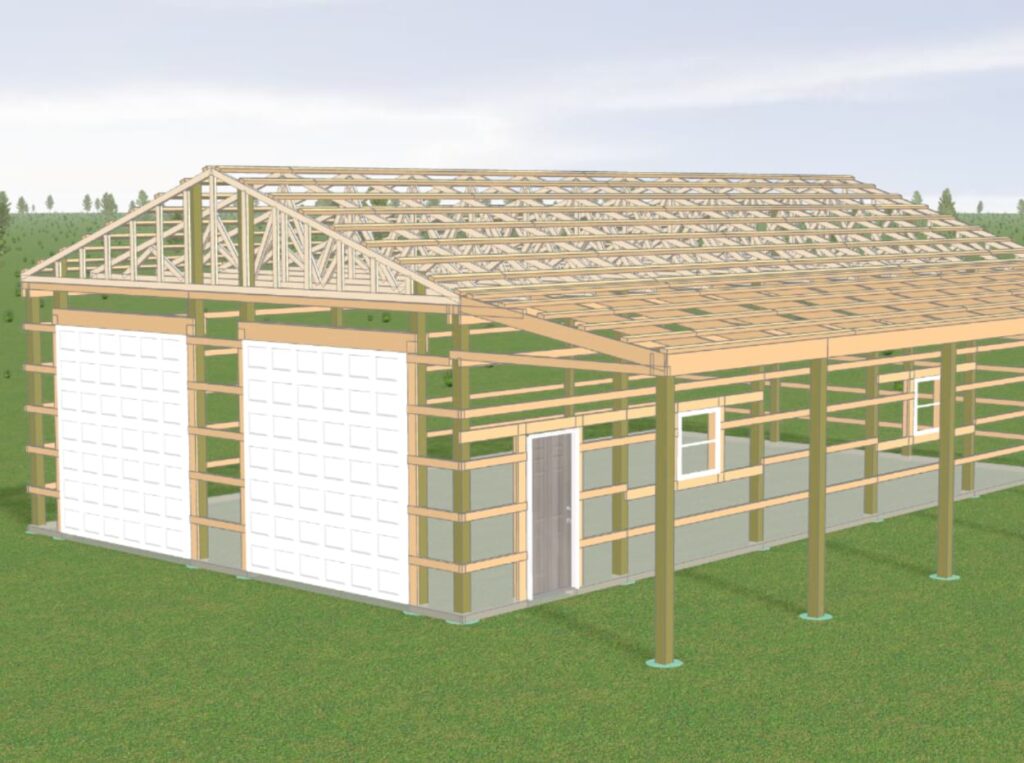
Project #1: Equipment Storage Barns
This is the most common pole barn project we build in Humphreys, Houston, Benton, and Perry counties. Farmers and rural property owners need a weatherproof place to park tractors, mowers, implements, and farm equipment without the cost and permitting involved in a full foundation.
Pole barns use 6×6 treated timber posts and engineered trusses that span the width, so you get wide-open interior space with no load-bearing walls in the way. A basic agricultural shell—open sides or enclosed with steel panels—protects equipment from weather and keeps maintenance costs down compared to leaving machinery outside year-round.
Cost depends on size, whether the structure is fully enclosed, and site conditions. For a real number on your property, get a quote.
Project #2: Workshop and Farm Shop Buildings
A workshop pole barn adds walls, doors, windows, and often insulation and electrical wiring to the basic post-frame structure. This is the project we build for property owners in Dickson, Hickman, and Henry counties who want a year-round workspace for welding, woodworking, equipment repair, or small business operations.
Finished pole barn workshops typically include:
- Insulated steel walls and roof to control temperature
- Service doors and at least one overhead door sized for equipment
- Electric service roughed in or fully wired
- Concrete floor poured inside (an added cost but worth it for most workshop use)
- Windows for natural light
The finished cost is higher than a simple equipment shelter, but you get a functional building that works in all weather. PAC builds both post-frame (pole barn) and stud-frame (stick-built) workshops—post-frame is faster to construct and often more economical for larger sizes, while stud-frame offers a traditional look and may be preferred for some residential settings or when matching existing structures.
Get a free, no-pressure quote at pacbuildingpro.com or call (931) 296-2777.
Project #3: Livestock Shelters and Horse Barns
Pole barns are a natural fit for livestock shelter because the post-frame method creates wide-open bays without interior supports. We build these regularly for cattle, horses, goats, and hay storage in Benton, Perry, Lewis, and Wayne counties.
Common livestock pole barn features include:
- Open front or partially enclosed sides for airflow
- Dirt or gravel floors (concrete is optional and adds cost)
- Lean-to additions for feed or tack storage
- Stall dividers and gates installed by the owner after construction
Agricultural buildings in Tennessee are exempt from the state building code under Tennessee law, which does not authorize requiring building permits for any building or structure on lands devoted to agricultural uses, provided that the building is incidental to the agricultural enterprise. However, each municipality may have its own exemptions and exceptions, so check with your local county or city codes office before starting construction. Some counties may ask for documentation such as an IRS Schedule F or agricultural exemption certificate to qualify for the exemption.
Project #4: Vehicle and RV Garages
Pole barns work well as vehicle garages when you need tall clearance for RVs, campers, boats, or farm trucks. We build these in Humphreys County and across the surrounding counties for customers who want covered parking without the expense of a full concrete-slab foundation and conventional stick-built garage.
Typical sizes for vehicle pole barns range from smaller two-car garages up to larger buildings for multiple vehicles and storage. The height can be customized to clear tall loads—important if you're storing an RV or a camper on a fifth-wheel hitch.
Whether you need a building permit depends on your location. In unincorporated Humphreys County (outside city limits), no building permit is required. Inside city limits in Waverly, New Johnsonville, or McEwen, a building permit is required from the city, and a county site close to city limits may need a separately purchased zoning permit. That's the rule for Humphreys County specifically—every other county and city in Middle Tennessee has its own requirements, so confirm with your local codes or zoning office before construction. The permit is the customer's responsibility.
Project #5: Combination-Use Barns
Many customers in Dickson, Stewart, Robertson, and Cheatham counties ask us to design a pole barn that serves more than one purpose—equipment storage on one end, enclosed workshop or office space on the other, or a combination of vehicle parking and livestock shelter.
Pole barns are flexible because the post-frame structure allows you to partition interior space without adding load-bearing walls. You can enclose part of the building and leave the rest open, or finish one bay with insulation and electric while keeping the rest as a basic shell.
This approach spreads the cost of construction across multiple uses and often makes more sense than building two separate structures. PAC works with you to design the layout that fits your property and budget.
| Project Type | Typical Features | Common Uses |
|---|---|---|
| Equipment Storage | Open or enclosed shell, dirt or gravel floor | Tractors, mowers, implements |
| Workshop / Farm Shop | Insulated walls, electric, concrete floor, overhead doors | Welding, woodworking, repair work |
| Livestock Shelter | Open front, dirt floor, optional stall dividers | Cattle, horses, hay storage |
| Vehicle / RV Garage | Tall clearance, enclosed walls, overhead doors | RVs, boats, farm trucks, equipment |
| Combination-Use | Partitioned interior, mix of open and enclosed bays | Storage + workshop, vehicles + livestock |
How Much Does a Pole Barn Cost in Middle Tennessee?
Pole barn cost depends on the size of the building, the level of finish, your site conditions, the materials you select, and whether the project qualifies as an agricultural structure. A basic agricultural shell costs far less than a finished, insulated workshop with electric service and a concrete floor.
Site work—grading, drainage, access for equipment—adds to the total cost if your property needs preparation before construction. Customizations such as extra doors, windows, insulation, and interior partitions all affect the final price.
PAC provides custom quotes based on your specific project and property in Humphreys County or the surrounding service area. We also offer financing for qualified buyers. Pole barns are custom structures built on-site, so they are not available on rent-to-own terms or with no-credit-check options. For an accurate number, request a free quote.
What About Building Permits and Engineered Plans?
Building permit requirements vary by location in Middle Tennessee. If your pole barn will not be used for living purposes, the state of Tennessee does not require a state residential building permit; however, building permit guidelines vary on a local level, and the permit authority is your local county or city building department.
In unincorporated Humphreys County (outside city limits), no building permit is required for pole barns. Inside city limits in Waverly, New Johnsonville, or McEwen, a building permit is required from the city. A county site close to city limits may need a separately purchased zoning permit. That is the rule for Humphreys County only—requirements vary by jurisdiction in every other county and city across Middle Tennessee.
Some counties and cities in Tennessee have withdrawn from or are exempt from the Tennessee State Building Codes, and rural counties vary significantly in permitting requirements for agricultural structures. Some unincorporated areas have no building code at all. Always confirm with your county or city codes office before starting construction.
PAC includes building drawings engineered for the local snow and wind loads with every custom pole barn build. Engineered or PE-stamped plans are not always required—whether you need them depends entirely on the local codes department for your county and whether your site is inside city limits. Many rural Middle Tennessee counties do not require engineered or stamped plans, while some cities and counties do. PAC can provide PE-stamped plans on request when a jurisdiction requires them, which adds cost and lead time. The building permit itself is the customer's responsibility.
Post-Frame or Stud-Frame?
PAC builds both post-frame (pole barn) and stud-frame (stick-built) garages, shops, and buildings. The difference matters depending on your project and site.
Post-frame construction uses pressure-treated posts set in the ground or on concrete pads instead of a continuous poured foundation. This method is faster to build, often more economical for larger structures, and well-suited to rural sites where a full foundation is not required or desired.
Stud-frame construction uses conventional 2×4 or 2×6 wall framing on a poured concrete foundation or slab. This method offers a traditional look, may be preferred in residential settings or when matching existing structures, and is sometimes required by local codes or HOA covenants.
Both methods produce durable, long-lasting buildings. The right choice depends on your budget, your site, your intended use, and any local code or deed restrictions. PAC can help you decide which construction method fits your project in Humphreys County or the surrounding Middle Tennessee area.
Frequently Asked Questions
Do I need a building permit for a pole barn in Humphreys County?
In unincorporated Humphreys County (outside city limits), no building permit is required. Inside city limits in Waverly, New Johnsonville, or McEwen, a building permit is required from the city, and a county site close to city limits may need a zoning permit. Requirements vary by jurisdiction in every other Middle Tennessee county, so confirm with your local codes office.
Are pole barns cheaper than stick-built garages?
Post-frame pole barns are often more economical for larger structures because they do not require a continuous poured foundation and can be built faster. Cost depends on size, finish level, and site conditions. PAC builds both post-frame and stud-frame buildings and can provide a custom quote for your project.
Does PAC provide engineered or stamped plans for pole barns?
PAC includes building drawings engineered for your local snow and wind loads with every custom pole barn. Whether PE-stamped plans are required depends on your county or city codes office—many rural Middle Tennessee counties do not require stamped plans. PAC can provide PE-stamped plans on request when a jurisdiction requires them, which adds cost and lead time.
Can I finance a pole barn in Middle Tennessee?
Yes, PAC offers financing for qualified buyers on custom pole barn projects. Pole barns are built on-site and are not available on rent-to-own or no-credit-check terms. Contact PAC for financing details and a free quote for your property.
Ready to start your pole barn project? PAC Building Pro serves Humphreys County and the surrounding Middle Tennessee area with custom post-frame and stud-frame buildings designed and built for your property. Get a free, no-pressure quote at pacbuildingpro.com or call us at (931) 296-2777.